Standing on a gravel bar with a tube under your arm, a river looks like one continuous sheet of moving water. It isn't. A river is a patchwork of lanes running at different speeds, and those differences are written on the surface in foam lines, wrinkles, and smooth dark patches. Learning to read them from dry land takes about ten minutes and will do more for your first float than any piece of gear. Here is how to look at a stretch of river and choose a line you can actually ride.
Start on the Bank, Not in the Water
Resist the urge to wade in and figure it out as you go. Find a spot where you can see a hundred yards or so upstream and the same downstream, then just watch for a few minutes. Three things tell you most of what you need to know.
- The angle of the surface. If the water visibly slopes away from you, gradient is doing work and the current will be strong. Steeper means faster, every time.
- Changes in width. A narrow constriction squeezes the same volume of water into less space, so it speeds up. Wide, shallow flats spread the flow out and slow it down.
- Floating debris. A leaf or twig is a free tracer. Track one from the top of your view to the bottom, and watch where it swings toward one bank or the other.
Do this before you inflate anything. The river you watched for two minutes is the river you are about to float.
The Surface Tells You Where the Water Is Fast
Riffles
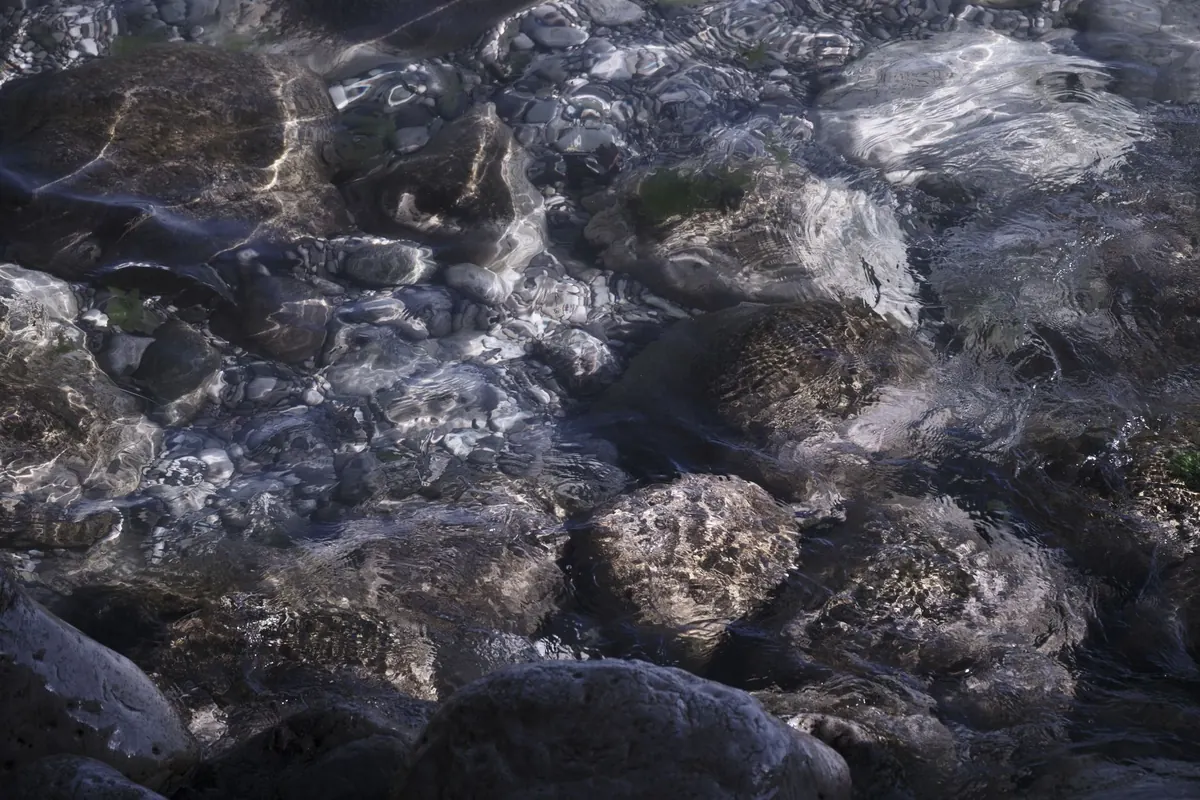
Riffles are the choppy, dimpled, broken stretches where shallow water tumbles over rocks. They look dramatic and sound loud, but they are usually the most forgiving water on the river because there is not enough depth to hold you. Look at the top of a riffle and you will see one or two smoother tongues cutting through the chop. Those tongues are the deeper, cleaner passages, and they are almost always the best line for a tube.
Glassy, Dark, Unbroken Water
Smooth water with no texture is deep water, and deep often means fast. It is not automatically bad, but it carries the most push of anything on the surface. A glassy tongue aimed straight at a fallen tree is a place you never want to be. Read dark water as a lane that will move you quickly and give you fewer chances to stand up or change your mind.
V-Waves and Foam Piles
A downstream-pointing V of waves forms where water is forced between two rocks, and the point of the V marks the chute. That chute is the clean route. A wave that curls back on itself, or a pile of foam that sits in one place and churns, is a hydraulic: water pushing upstream on the surface. Small ones are often rideable. Bigger ones can hold a tube and a person. From the bank, note where they are and choose a line that skips them entirely.
Eddies Are Your Rest Stops and Exit Ramps
Find the seam, the line of foam or the visible break where fast water meets slow. Behind every rock, bridge pier, or point of bank that juts into the current, water curls back upstream to fill the space it left behind. That curl is an eddy, and it is your friend.
Eddies matter for three reasons. They are rest stops, where you can kick over, catch your breath, and look downstream. They are exits, because most good take-outs sit in an eddy or in the slow water just below one. And they are launch pads, since the seam itself gives you a shove when you cross it heading downstream.
Beginners do best by entering an eddy near its upstream end, where the seam is softest. A strong eddy line can spin a tube like a coin. If you only want to pause, aim for the middle of the calm pocket and stay there.
Pick Your Line With Three Points
Before you get in, choose three points and say them out loud to whoever is floating with you.
- Entry: a spot where the water at the edge is slow and the path into the current is clear.
- Midpoint: something you can see from upstream and aim for, such as a tongue of smooth water between two rocks or the seam of an eddy.
- Exit: the eddy or gravel bar where you plan to get out, decided before you are moving toward it.
If you can, walk downstream along the bank and scout the stretch you could not see from the put-in. Rivers bend, and the line that looks clean from the top often disappears behind a tree around the corner. On runs where walking back is not practical, leave a vehicle at the take-out.
Signals That Mean Walk Away
Some water is not beginner water, and no amount of nerve changes that. Portage around these on the bank.
- A horizon line with no visible water below it, meaning a drop you cannot see past.
- Strainers: fallen trees, brush, fence wire, or anything the current runs through. Water pushes you under and pins you, and no tube beats that.
- Fast water in a narrow channel with no eddies along either bank.
- A rising, muddy river after rain. High water is a different river with different lines. Check the local gauge or ask an outfitter what the current level means.
- Any stretch where you cannot point to a place to get out.
Your Five-Minute Riverbank Checklist
- Watch the surface for two or three minutes and follow one twig all the way through your view.
- Mark three eddies you could reach if you needed to stop.
- Locate every strainer and hydraulic, then choose the line that misses them.
- Confirm entry, midpoint, and exit.
- Verify your take-out is where you think it is, using a map or a local outfitter.
- Check water level, weather, water temperature, and local rules for the stretch.
- Gear up on land: PFD buckled, closed-toe shoes, helmet where rocks or wood warrant one, and nothing dangling that can snag.
Before You Push Off
Float feet-first on your back with your toes up, and keep your feet up in anything fast. Standing in moving water is how feet get trapped between rocks, so save standing for the shallow, slow edge. Never tube alone, carry a throw rope on bigger water, and leave your plans with someone on shore. If you have health concerns about cold water or exertion, talk to a doctor before you go, and when in doubt about a stretch of river, ask the people who run it every week.
Reading a river from the bank becomes a habit within a float or two. It is the skill that turns a nervous first run into one you want to repeat next weekend.
Photo: ervin.fon Trichev / Pexels